
The Context
In April 1932, DeBakey, then a medical student, sat down to write a letter that was less a friendly family update and more of a financial manifesto. He was living in what he described as the “worst neighborhood in New Orleans.” [It’s not anymore, by the way.]
His life then was a series of calculated compromises. To keep his car safe from the tough elements of the neighborhood, he paid $5.00 a month for a garage. Every cent was accounted for: he negotiated a discount on gasoline and performed his own oil changes and greasing to save money. He was even paying off a set of medical books in $3.00 installments, a debt that loomed over him for ten months.
His money woes were taking a toll. DeBakey admitted to his parents that he had been losing weight. He contracted with a local café to buy a pint of milk every night for five cents, a discount from the usual dime. This letter depicts a man fighting to justify every expense: even haircuts, at a dollar a month.
This letter serves as a kind of “dark before the dawn” story. It establishes the disciplined, almost monastic lifestyle DeBakey maintained to achieve his goals. By the time we reach March 12, 1934, the tone shifts to reflect a man who has survived the gauntlet. The lean student had transformed into a professional with a clear path forward.

The Story
In this brief but potent letter, we witness a profound moment of transition in a doctor’s young life. While financial matters still anchor the exchange, the focus has pivoted from mere survival to the pursuit of high ambitions.
He shares his potential successes that have transitioned from ideas to useful and marketable inventions. For the first time, DeBakey mentions the possibility of being rewarded financially, hinting that the days of meticulous expense-tracking may finally be coming to an end.
He speaks of his father’s influence and his own deep-seated hope to eventually prove himself worthy of the man who supported him through the lean years.
This letter serves as a catalyst for Michael DeBakey’s career; the moment when his inventive mind began to produce results. It is a letter that shows deep gratitude and the quiet confidence of a man who knows he is on the verge of something that may change his life, and the lives of others, forever.
The History
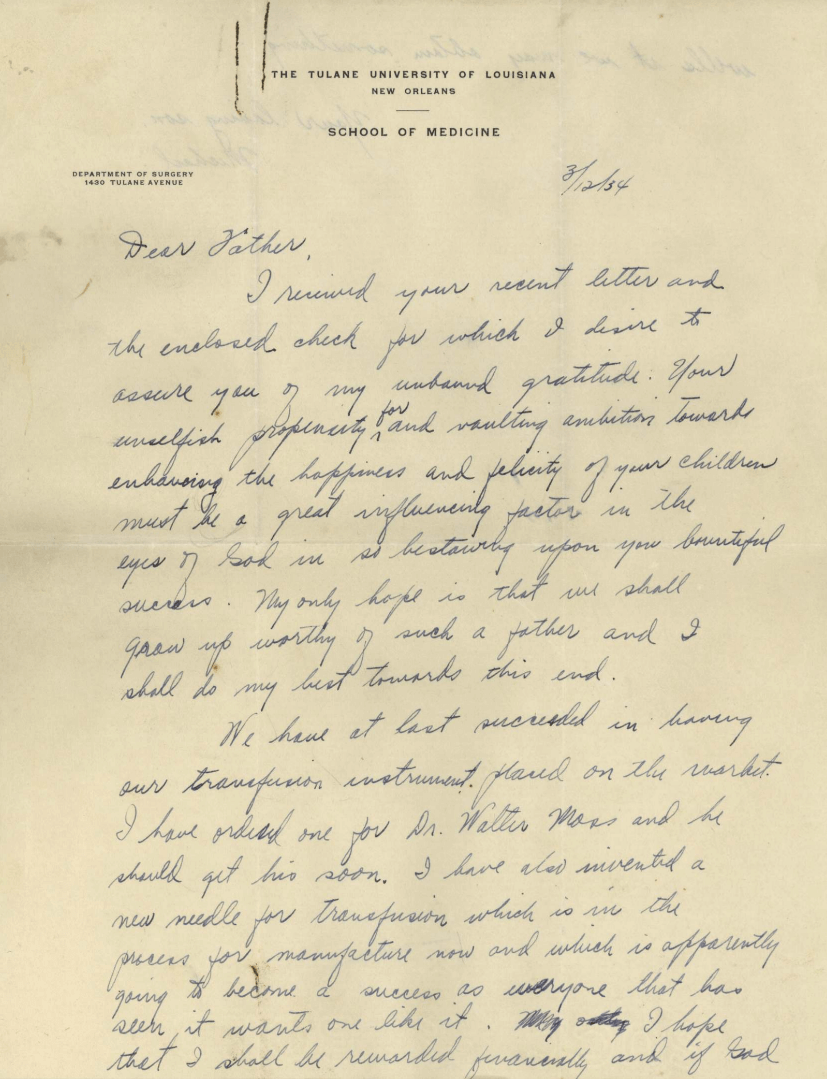
March 12, 1934
I received your recent letter and the enclosed check for which I desire to assure you of my unbound gratitude.
Your unselfish propensity for, and vaulting ambitions toward, enhancing the happiness and felicity of your children must be a great influencing factor in the eyes of God in so bestowing upon your bountiful success.
My only hope is that we grow up worthy of such a father, and I shall do my best towards this end.
We have, at last, succeeded in having our transfusion instrument placed on the market. I have ordered one for Dr. Waller Moss, and he should get his soon. I have also invented a new needle for transfusion, which is in the process for manufacture now, and which is apparently going to become a success, as everyone that has seen it wants one like it.
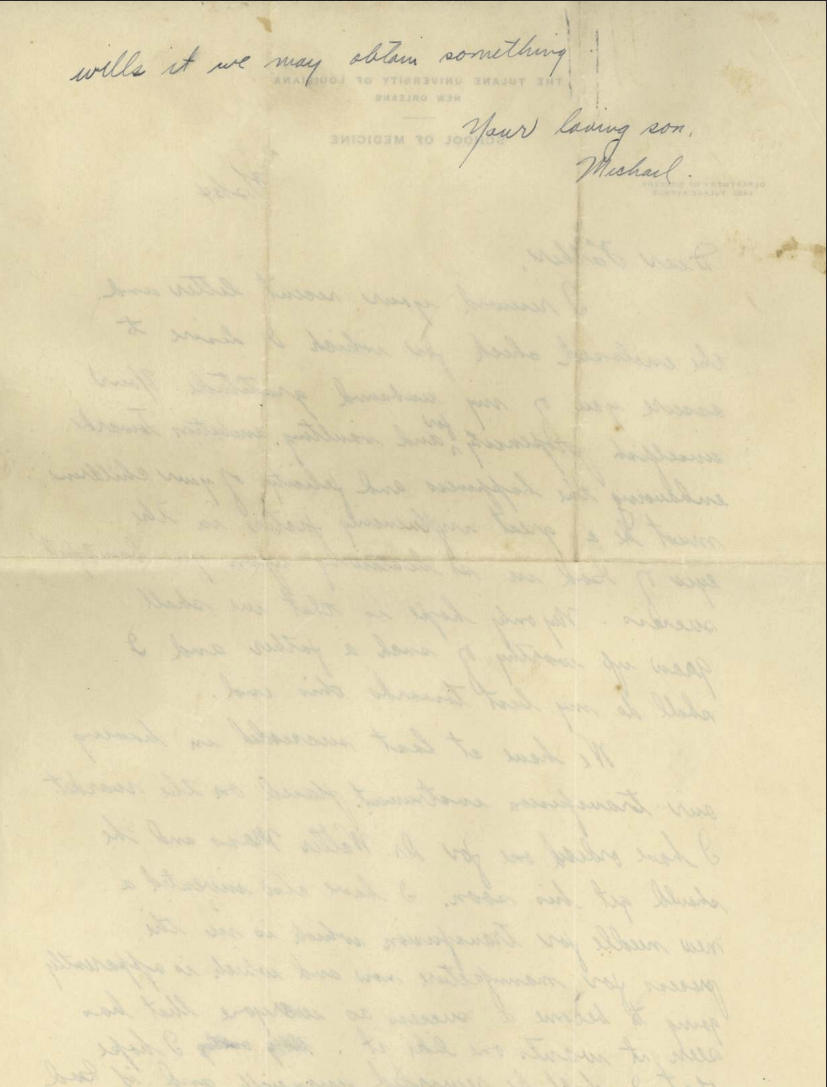
I hope that I shall be rewarded financially, and if God wills it, we may obtain something.
I am with great respects your friend
& obt Servt.
David Crockett
Charles Shultz
P.S. will you get a paper from your editor that Contains the procedings of the day I Spent in your City last Summer on my way home pleas to get it and enclose it to me as soon as convenient and oblidge your friend D.C.
[written on margin of first page]
Presented to Dr. Cahern by his friend and obliged svt.
Baet. March 7, 1840 Mr. Ogden Niles