
Context
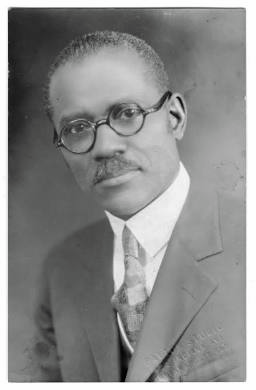
Born in Bastrop County, Texas, in 1875, Edwin D. Moten experienced hardship early.
Following his father’s death in 1888, young Edwin worked in cotton compresses, oil mills, and on the Galveston Wharves to support his widowed mother and younger siblings before putting himself through Virginia’s Hampton Institute, and Shaw University’s Leonard Medical College.
After graduation he married and settled in Quakertown – a self-sufficient middle class, African American neighborhood in Denton, Texas, where he practiced medicine as the only Black physician in Denton County. His wife, Susie, was an educator, teaching at the local school, aptly named Fred Douglass.
Edwin’s hard-won stability ended in the early 1920s.
Seeking to clear the black enclave situated directly adjacent to an all-white college (now Texas Women’s University) Denton civic leaders passed a 1921 bond election to replace Quakertown with a segregated, whites-only city park. Using eminent domain and intimidation, city officials dismantled the community and pushed remaining Black residents to an undeveloped tract on the edge of town.
Rather than submit to forced relocation, Edwin moved his family north to Indianapolis, Indiana where they rebuilt their lives.
By the time this letter was written in November, 1945, World War II had ended a few months earlier, and Thanksgiving Day was approaching, and with it a sense of relief and gratitude. Edwin’s son, Don, was coming home from the war.
Dr. Edwin Moten was now 70 years old. This remarkable man had weathered his share of personal and professional storms. Don returned from war to a country still unprepared and unwilling to grant full rights and freedom to African Americans.
After his discharge, Edwin Donerson “Don” Moten, Jr. attended college and launched his own successful career as an optometrist in Indianapolis.
Success as an act of defiance and perseverance, despite the odds. How American is that.
The Story
In the autumn of 1945, the world was exhaling after years of global conflict, yet inside the Moten household, the war was not quite over.
For Dr. Edwin D. Moten, a respected physician and patriarch, the Thanksgiving season brought a complicated mix of deep gratitude and quiet, gnawing anxiety. His son, Don, was finally back on American soil, yet the United States Army had not yet released him from duty.
Edwin understood his son’s frustration. Don was an educated, married young man, ready to finish his schooling and make his mark on the world. Being held in limbo by military bureaucracy while other soldiers were being mustered out could cause negative responses, especially for a young man eager to start his civilian life.
However, Edwin’s life experience as a Black man in America had taught him a painful, non-negotiable truth about survival. He knew that in the segregated military—and in the broader society—the rules of engagement were starkly different for Black men than they were for their white counterparts. A white soldier might openly grumble about military delays, question an officer’s fairness, or join fellow troops in vocalizing disgust without facing catastrophic consequences. For a Black soldier, however, even a hint of sullenness, defiance, or visible discontent could be weaponized by biased officials, leading to harsh retaliation, ruined prospects, or worse. The stakes were high.
As his wife and daughter prepared the holiday turkey and fixings in a warm, bustling home, Edwin sat down to write to his son. Behind the scenes, Edwin was already working his own networks. Yet he knew that no amount of effort from home could protect Don if the young man lost his temper.
With the fierce, protective love of a father who knew the precariousness of his son’s position, Edwin put pen to paper—not to scold, but to offer a survival guide. He needed Don to swallow his pride, keep his head down, and navigate the treacherous waters of military authority with strategic grace until he could finally walk through the front door safe and sound.
And he did.
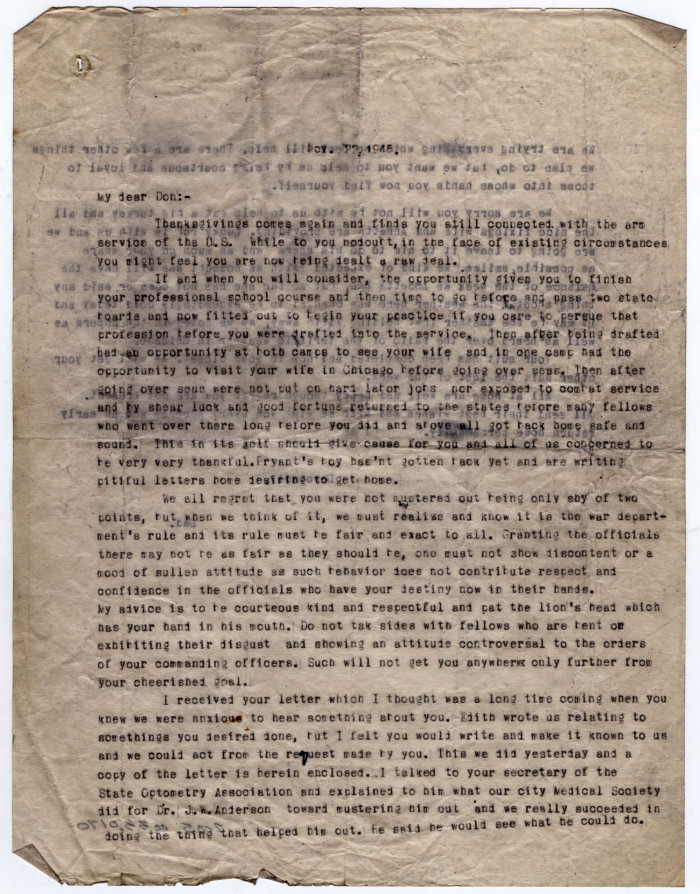
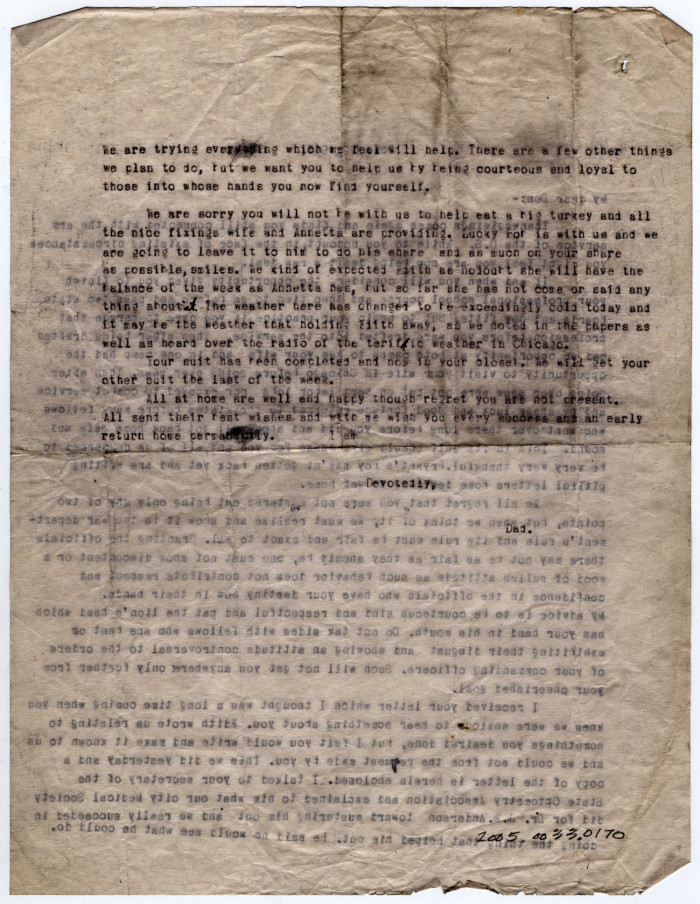
The Transcript
November 22, 1945
My Dear Don,
Thanksgiving comes again and finds you still connected to the Armed Forces of the U.S. While o you, no doubt, in the face of existing circumstances, you might feel you are being dealt a wrong deal.
If and when you will consider the opportunity given you to finish your professional school course and then time to go before and pass two state boards and now fitted out to begin your practice; if you care to pursue that profession before you were drafted into the service. Then, after being drafted, had the opportunity at both camps to see your wife, and in one camp, had the opportunity to visit your wife in Chicago before going overseas.
Then, after going overseas you were not put on hard labor jobs nor exposed to combat service, and by sheer luck and good fortune returned to the states before other fellows who went over there before you did, and above all, you got back safe and sound. This in itself should give cause for you and all of us concerned to be very thankful. Bryant’s boy hasn’t gotten back yet and is writing pitiful letters desiring to get home.
We all regret that you were not mustered out, but when we think of it, we must realize and know it is the War Department’s rule and its rule must be fair and exact to all.
Granted, the officials there may not be as fair as they should be. One must not show discontent or they may not be as fair as they should be. One must not show discontent or a mood of sullen attitude, as such behavior does not contribute respect and confidence in the officials who have your destiny now in their hands.
My advice is to be courteous, kind, and respectful, and pat the lion’s head which has your hand in its mouth.
Do not take sides with fellows who are bent on exhibiting their disgust and showing an attitude controversial to the orders of your commanding officers. Such [actions] will not get you anywhere, only further from your cherished goal.
I received your letter, which was a long time coming, when you knew we were anxious to hear something about you… We are trying everything which we feel will help. There are a few things we plan to do, but we want you to help us by being courteous and loyal to those into whose hands you now find yourself.
We are sorry you will not with us to eat a big turkey, and all the nice fixings your mother and Annetta are providing. Lucky Fox is with us and we are going to leave it to him to do his share, and as much on your shar as possible (smiles!).
Your suit has been completed and is now in your closet. We will get your other suit at the end of the week.
All at home are well and happy though regret you are not present. All send their best wishes, and with me, wish you every success and an early return home, permanently.
Devotedly,
Dad
Moten, Edwin D., Sr. [Letter from Dr. Edwin D. Moten to Don Moten, November 22, 1945], letter, November 22, 1945, Denton County Courthouse-on-the-Square Museum.
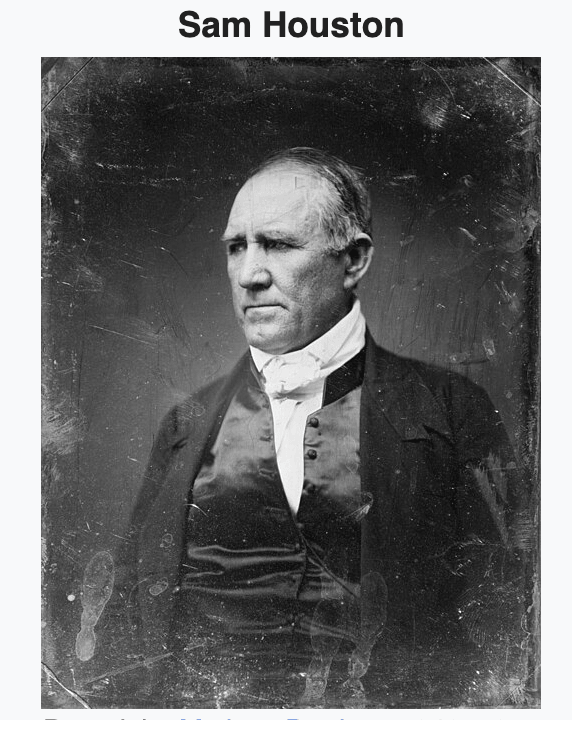
A conversation across time
Comments are welcome.
Write to Buck